Among the traditional card games cherished throughout the Philippine archipelago, Pusoy Dos (the Filipino adaptation of international "Big Two" or "President") stands as a premier test of tactical card shedding, positional play, and hand-reading ability. Played among four participants using a standard 52-card deck, the game challenges players to be the first to shed all thirteen cards dealt into their hand. Combining tactical card combinations with the supreme authority of the 2 of Spades (Dos), Pusoy Dos delivers fast-paced, highly engaging card entertainment in real-money digital lobbies.
This technical guide provides an independent, comprehensive analysis of Pusoy Dos Online. We examine the unique card hierarchy, deconstruct 5-card poker combinations, explain how controlling the lead dictates table momentum, review scoring calculations, and provide essential bankroll protection advice tailored for Filipino players utilizing GCash and Maya.
The Unique Card and Suit Hierarchy of Pusoy Dos
The most critical fundamental concept in Pusoy Dos is that card and suit rankings differ substantially from standard international poker:
Card Rank Hierarchy (Highest to Lowest):
$$\mathbf{2} \text{ (Dos)} > \mathbf{A} > \mathbf{K} > \mathbf{Q} > \mathbf{J} > \mathbf{10} > \mathbf{9} > \mathbf{8} > \mathbf{7} > \mathbf{6} > \mathbf{5} > \mathbf{4} > \mathbf{3}$$- The 2 (Dos) is the highest card in the game, completely dominating all Aces and Kings.
- The 3 is the lowest card in the game.
Suit Hierarchy (Highest to Lowest):
$$\text{Spades (Highest)} > \text{Hearts} > \text{Clubs} > \text{Diamonds (Lowest)}$$The 2 of Spades is the single most powerful individual card in the entire deck, capable of beating any other single card played on the table.
Playable Hand Combinations
Players must shed cards by playing valid combinations that match the category of the opening lead while beating its rank:
| Combination Type | Description | Evaluation Rule |
|---|---|---|
| Single Card | Any solitary card | Evaluated by rank, then by suit (e.g., 2 of Spades beats 2 of Hearts) |
| Pair | Two cards of identical rank | Evaluated by rank, then by the suit of the highest card in the pair |
| Three of a Kind (Trio) | Three cards of identical rank | Evaluated strictly by rank (e.g., three 8s beat three 5s) |
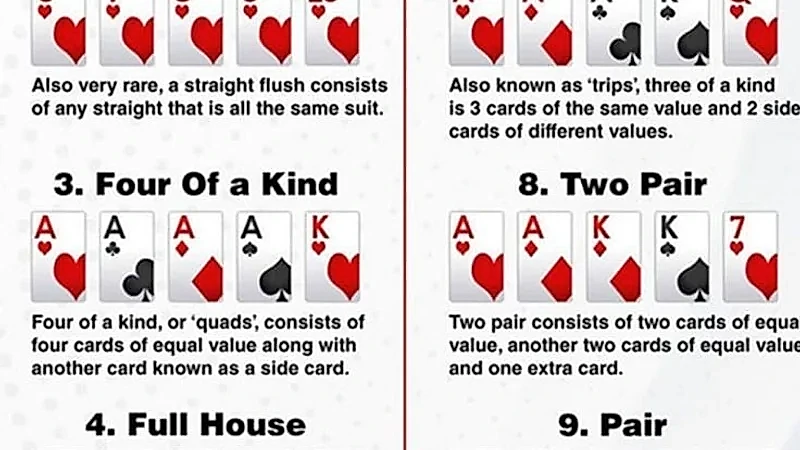
| 5-Card Poker Hand | Straight, Flush, Full House, Four of a Kind, Straight Flush | Evaluated by 5-card poker hierarchy detailed below |
The 5-Card Combination Hierarchy in Pusoy Dos
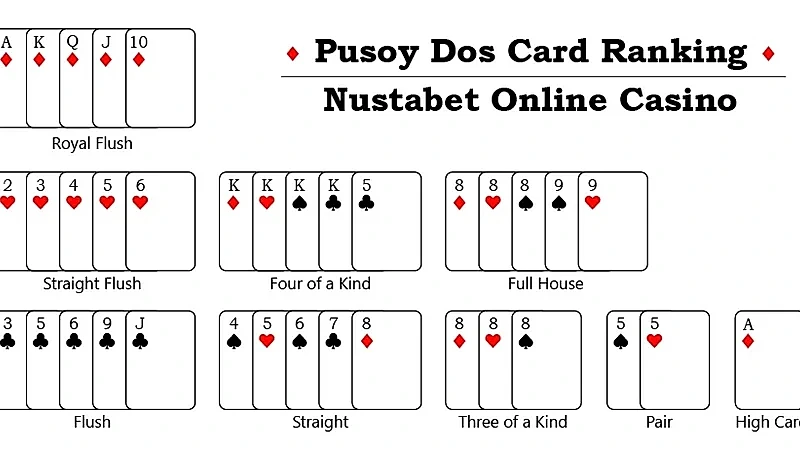
When a player leads with a 5-card combination, subsequent players must play a higher-ranking 5-card combination:
``` +-------------------------------------------------------+
+-------------------------------------------------------+
| 1. Straight: 5 consecutive cards of mixed suits |
|---|
| 2. Flush: 5 cards of the same suit (not in sequence) |
| 3. Full House: Three of a kind plus a pair |
| 4. Four of a Kind: 4 cards of same rank + 1 kicker |
| 5. Straight Flush (Royal Flush): 5 consecutive cards |
| of the same suit (The ultimate 5-card powerhouse) |
+-------------------------------------------------------+ ```
A Full House beats any Straight or Flush, while a Four of a Kind beats all Full Houses, Flushes, and Straights.
Turn-by-Turn Mechanics: The Opening Lead and Table Control
- The Opening Lead: The player holding the 3 of Clubs (the lowest card in the game) makes the opening lead and must include the 3 of Clubs in their opening play (as a single, pair, or 5-card hand).
- Following the Lead: Play moves counter-clockwise. Each subsequent player must either play a higher combination of the exact same category or pass.
- Regaining Table Control: If all other three players pass, the table clears. The player who played the highest uncontested combination earns Control of the Lead and may play any new combination of their choice.
Scoring and Penalty Systems: Avoiding "Pusoy"
When one player sheds their final card, the game concludes immediately, and penalties are assessed based on the cards remaining in opponents hands:
| Hand Status at Game End | Card Count Remaining | Financial Penalty Assessed |
|---|---|---|
| Standard Penalty | 1 to 9 cards remaining | 1 Point per card remaining in hand |
| Double Penalty | 10 to 12 cards remaining | 2x Multiplier (2 Points per card remaining) |
| Triple Penalty (Pusoy / Full Hand) | All 13 cards remaining | 3x Multiplier (3 Points per card; severe financial penalty) |
Tactical Strategies for Pusoy Dos Players
- Shed Heavy Deadwood When Given the Opportunity: If you gain the lead but hold weak cards, lead with single low cards to shed deadwood rather than holding out for impossible combinations.
- Preserve Your Dos for Crucial Interceptions: Do not spend your 2 of Spades prematurely on trivial rounds. Save your highest cards to seize control of the lead when you are ready to dump your remaining cards.
- Avoid Getting Caught with 10+ Cards: If an opponent is down to 2 or 3 cards, play aggressively to reduce your hand below 10 cards to avoid double or triple penalty multipliers.
Regulatory Oversight and Responsible Play
Digital multiplayer Pusoy Dos platforms operate under peer-to-peer matchmaking software monitored under regulatory guidelines set by PAGCOR. Automatic card shuffling operates on certified Random Number Generators that prevent deck rigging.
Real-money online gaming is strictly restricted to adult individuals aged 21 and above in the Philippines. Treat card gaming as social recreational leisure. For confidential support regarding gambling habits, consult Gamblers Anonymous or BeGambleAware.
Positional Advantage and The Control of the Lead
In competitive Pusoy Dos, possessing the lead card is the single most powerful tactical advantage. The player who controls the lead dictates whether the round is contested in singles, pairs, triples, or five-card hands:
| Game Stage | Strategic Objective | Optimal Tactical Play |
|---|---|---|
| Opening Round | Seize initial tempo from the Three of Clubs | Use a mid-tier pair or five-card sequence to wrest control early |
| Mid Game | Exhaust opponents high cards and twos | Play single low cards to force out enemy 2s or Aces |
| End Game (Opponent has 1-2 cards) | Prevent opponents quick exit | Lead with your strongest five-card combination or highest pair |
Comprehensive Hand Hierarchy and Point Systems
Pusoy Dos ranks five-card combinations according to traditional poker standards, but card suit hierarchies heavily influence showdowns:
- Straight: Five consecutive cards. Ranked first by the highest card in the sequence. In the event of identical high cards, the suit of the highest card determines the winner.
- Flush: Five cards of the same suit. Ranked first by the suit hierarchy (Diamonds high, Clubs low), and secondly by the highest individual card.
- Full House: A combination of three matching cards and one pair. Ranked entirely by the rank of the triple (e.g., three Kings with a pair of 4s beats three Jacks with a pair of Aces).
- Four of a Kind (Quads): Four cards of identical rank accompanied by any fifth card. Only beaten by a Straight Flush or a higher Quad.
- Straight Flush (and Royal Flush): Five consecutive cards of the same suit. The undisputed supreme five-card combination.
Fast Wallet Settlement and GCash/Maya Cashouts
Playing Pusoy Dos online provides seamless financial utility through Philippine mobile payment infrastructure:
- Automatic Table Stakes: When joining a table, your table buy-in is locked in real-time escrow. Winnings are settled into your main balance instantly upon round completion.
- Swift Withdrawal Processing: Transfer accumulated card winnings directly into your personal verified GCash or Maya wallet with zero manual paperwork.
- Fair Play Algorithms: Online table card dealing uses verified RNG algorithms certified by independent auditors and monitored under PAGCOR regulations.
Comparison of Pusoy Dos Against Standard Western Poker and Chinese Poker
While Pusoy Dos shares superficial card ranking similarities with other popular card games, its strategic mechanics are fundamentally distinct:
| Game Variant | Primary Victory Condition | Suit Hierarchy Relevance | Strategic Focus |
|---|---|---|---|
| Pusoy Dos (Big Two) | First player to discard all 13 cards | Paramount (Diamonds > Hearts > Spades > Clubs) | Tempo control, discarding low singles, card exhaustion |
| Texas Hold'em Poker | Forming the single highest 5-card hand | Suits carry identical weight | Betting psychology, pot odds, bluffing, position |
| Traditional Pusoy (Chinese Poker) | Arranging 13 cards into 3 distinct winning rows | Standard poker rankings determine each row | Hand structuring, minimizing fouling, risk balancing |
Mastering these distinctions prevents poker players from making structural mistakes, such as undervaluing suit strength or overvaluing unplayable high cards late in a hand.