In the cultural fabric of the Philippines, few games command as much nostalgia, strategic fascination, and social camaraderie as Tongits. Originally popularized in the northern provinces of Luzon during the 1990s, this three-player rummy-style card game has evolved from informal neighborhood tables and fiesta gatherings into one of the most widely played real-money electronic card games in the country. Digital multiplayer lobbies allow Filipino players to test their tactical meld-building skills against real opponents nationwide, wagering real Philippine Pesos via GCash and Maya.
This technical guide provides an independent, comprehensive breakdown of Tongits Online. We deconstruct the card hierarchy and meld combinations, explain the rules governing the "Draw," "Drop," "Chow," and "Fight" phases, contrast standard winning conditions with special outcomes like "Tongits" and "Burn," and provide essential bankroll protection advice for real-money card rooms.
Fundamental Objective and Card Distribution
Tongits is played using a standard 52-card international deck with no jokers. The game accommodates exactly three players participating in a competitive, turn-based elimination format:
| Game Element | Card Allocation & Valuation | Strategic Player Objective |
|---|---|---|
| Starting Hand Deal | Dealer receives 13 cards; other two players receive 12 cards | Organize starting cards into valid melds and plan initial discards |
| Card Point Values | Aces = 1 point; 2 to 9 = Face value; 10, J, Q, K = 10 points each | Minimize the total numeric point count of unmelded cards in hand |
| Central Stockpile | Remaining 15 cards placed face down in center draw pile | Serves as draw reserve; game ends when stockpile is fully exhausted |
| Primary Winning Goal | Form melds, empty your hand (Tongits), or hold the lowest point count | Call "Draw" or force opponents into card "Burn" penalties |
Valid Meld Configurations (Bahay)
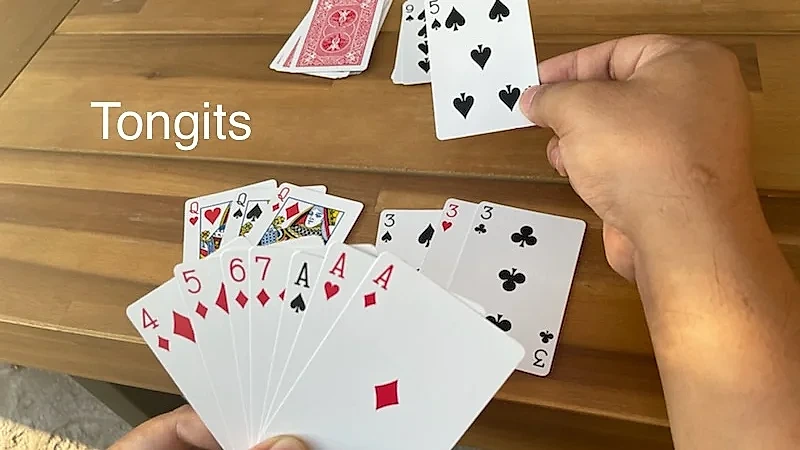
To reduce your hand point total and establish eligibility to call a "Draw," players must combine cards into valid melds, colloquially known in the Philippines as Bahay:
``` +-------------------------------------------------------+
+-------------------------------------------------------+
| 1. Sequences / Straight Flushes (Escalera): |
|---|
| - Three or more consecutive cards of the SAME suit |
| - Example: 4 of Spades, 5 of Spades, 6 of Spades |
+-------------------------------------------------------+
| 2. Sets / Groups (Barkada): |
|---|
| - Three or four cards of the SAME rank in DIFF suits |
| - Example: 8 of Hearts, 8 of Diamonds, 8 of Clubs |
+-------------------------------------------------------+
| Special Note: Aces can only be low (A-2-3); |
|---|
| A sequence of Q-K-A is NOT a valid meld in Tongits. |
+-------------------------------------------------------+ ```
Turn-by-Turn Mechanics: Draw, Chow, Drop & Sapaw
Play proceeds counter-clockwise around the table. On your turn, you must execute the following tactical sequence:
- 1. Acquire a Card (Draw or Chow): You must either draw the top face-down card from the central stockpile OR "Chow" the card discarded by the player immediately to your right (only permitted if that card completes an immediate meld from your hand).
- 2. Expose Melds (Drop / Bahay): If you hold valid melds, you may lay them face up on the table. You must expose at least one valid meld to be eligible to challenge a Draw.
- 3. Lay Off Cards (Sapaw): You can attach matching cards from your hand onto existing exposed melds belonging to yourself or any opponent (e.g., adding an 8 of Spades to an opponent set of three 8s).
- 4. Mandatory Discard: Conclude your turn by discarding one card face up onto the central discard pile.
Winning Conditions: Tongits, Draw & The Dreaded "Burn"
A round of Tongits concludes under one of three distinct conditions:
| Conclusion Scenario | How It Occurs | Payout Distribution |
|---|---|---|
| Calling "Tongits" | A player empties their entire hand by melding, sapaw, and final discard | Instant victory; winner collects standard pot plus Tongits bonus stakes |
| Challenging a "Draw" | A player with exposed melds believes they hold the lowest deadwood points | Opponents can "Fold" or "Fight"; lowest point count wins the pot |
| Stockpile Exhaustion | Central draw pile runs completely dry without a declared winner | All players tally deadwood points; lowest total hand score wins |
| The "Burn" Penalty | A player fails to expose a single meld before the game concludes | Player is marked "Burned"; forfeits pot and pays penalty fines |
Tactical Strategies for Real-Money Card Rooms
Winning consistently at Tongits requires tactical acumen, memory tracking, and disciplined bankroll management:
- Discard High Cards Early: If face cards (Kings, Queens, Jacks, 10s) cannot form immediate melds, discard them during the opening two rounds. Holding high deadwood cards exposes you to severe losses if an opponent calls a sudden Draw.
- Track Opponent Discards: Observe which suits and ranks your opponents discard or Chow. Never discard a card that directly assists the player to your left.
- Avoid Getting Burned: Expose at least one solid meld as soon as you have drawn safely, ensuring you avoid the heavy financial penalties of getting Burned.
Regulatory Oversight and Responsible Play
Digital multiplayer Tongits rooms operate under peer-to-peer matchmaking software monitored under regulatory guidelines set by PAGCOR. Automated card dealing operates on certified Random Number Generators that prevent deck manipulation.
Real-money gaming is strictly restricted to adult individuals aged 21 and above in the Philippines. Treat card gaming as social recreational leisure. For confidential support regarding gambling habits, consult Gamblers Anonymous or BeGambleAware.
Advanced Defensive Play and Sapaw Prevention Tactics
Mastering Tongits requires shifting from purely building your own combinations to actively monitoring what your opponents are accumulating on the virtual table:
| Defensive Scenario | Tactical Vulnerability | Recommended Countermeasure |
|---|---|---|
| Opponent opens an exposed Melded Run | You hold cards that can extend their run | Hold the card until late game or dump it when safe |
| Opponent refuses to pick from the discard dump | Opponent is fishing for concealed Secret sets | Discard unranked middle cards (7s, 8s) early |
| Discard pile is nearing the 36-card limit | Low-point players will call a premature Draw | Dump your highest face cards (Kings, Queens, Jacks) immediately |
| Left-hand player is aggressive | Discarding matching suits gives them Free Melds | Alter discard patterns to opposite colors and ranks |
Point Counting Values and Burned Hand Penalties
When no player achieves an outright Tongits and the central stock deck is completely exhausted, the round proceeds to final card count showdown:
- Aces: Valued at 1 point each.
- Number Cards (2 through 9): Valued at their exact printed face value (2 to 9 points).
- Face Cards (10, Jack, Queen, King): Valued at 10 points each.
- Sunog (Burned) Hand Penalty: If a player fails to lay down at least one valid Meld throughout the entire hand before a Draw is called or another player declares Tongits, that player is declared "Sunog". A burned player forfeits the entire stake and is barred from participating in the pot payout regardless of hand points.
Pot Money Settlement and Responsible Gaming Controls
Online Tongits tables feature micro-stakes and high-stakes rooms suited for every player level:
- Automated Pot Deduction: Table buy-ins and ante deductions are processed automatically from your primary platform wallet with zero manual chip disputes.
- Time-Bank Limits: Players have strict 12-second decision timers per turn. If a player disconnects, an automated system plays the safest discard to keep table action moving smoothly.
- Responsible Entertainment: Tongits is an exhilarating social card game, but players should maintain rigid financial boundaries. Access support resources via BeGambleAware and GamCare if gaming begins impacting your daily routine.